
Strength Training for Runners
Endurance athletes are some of the most “in-tune” athletes I have ever worked with. Whether or not they have a formal physiology background, they have a solid foundation and understanding of exercise physiology, they are in-tune with nutrition (fueling, hydrating, preparing for races and long training days), they value recovering and getting ample sleep, they understand testing metrics like VO2max and lactate threshold, and they are always looking for ways to improve in their performance. Most runners are familiar with strength training and know that it is “good for you”. But, I do believe there are still some common misconceptions of strength training in the running and endurance world, and the approach some athletes take is either outdated or non-beneficial.
Some people still think strength training for endurance athletes is just high reps, low load. Some people still believe strength training is just bodyweight exercises and core. Others may have a more up to date perspective but they still look at it as just an injury prevention intervention. In this article, I want to highlight the benefits of strength training for running performance while clearing up some misconceptions.
What Does Running Require?
Running is not just about endurance and having a solid cardiovascular foundation. Running is a complex interaction of strength, power, coordination, elasticity, and efficiency. There is a force requirement involved because each stride requires force production. When your foot contacts the ground, your body has approximately 150–250 milliseconds to absorb force, stabilize the body, and propel yourself into the next stride. You repeat this process thousands of times during a race.
Running requires the ability to:
Produce force every stride
Produce that force quickly
Repeat that force economically
Maintain technique under fatigue
Strength training plays a role in enhancing the quality of every step rather than simply increasing aerobic fitness.
The Quads and Plantar Flexors
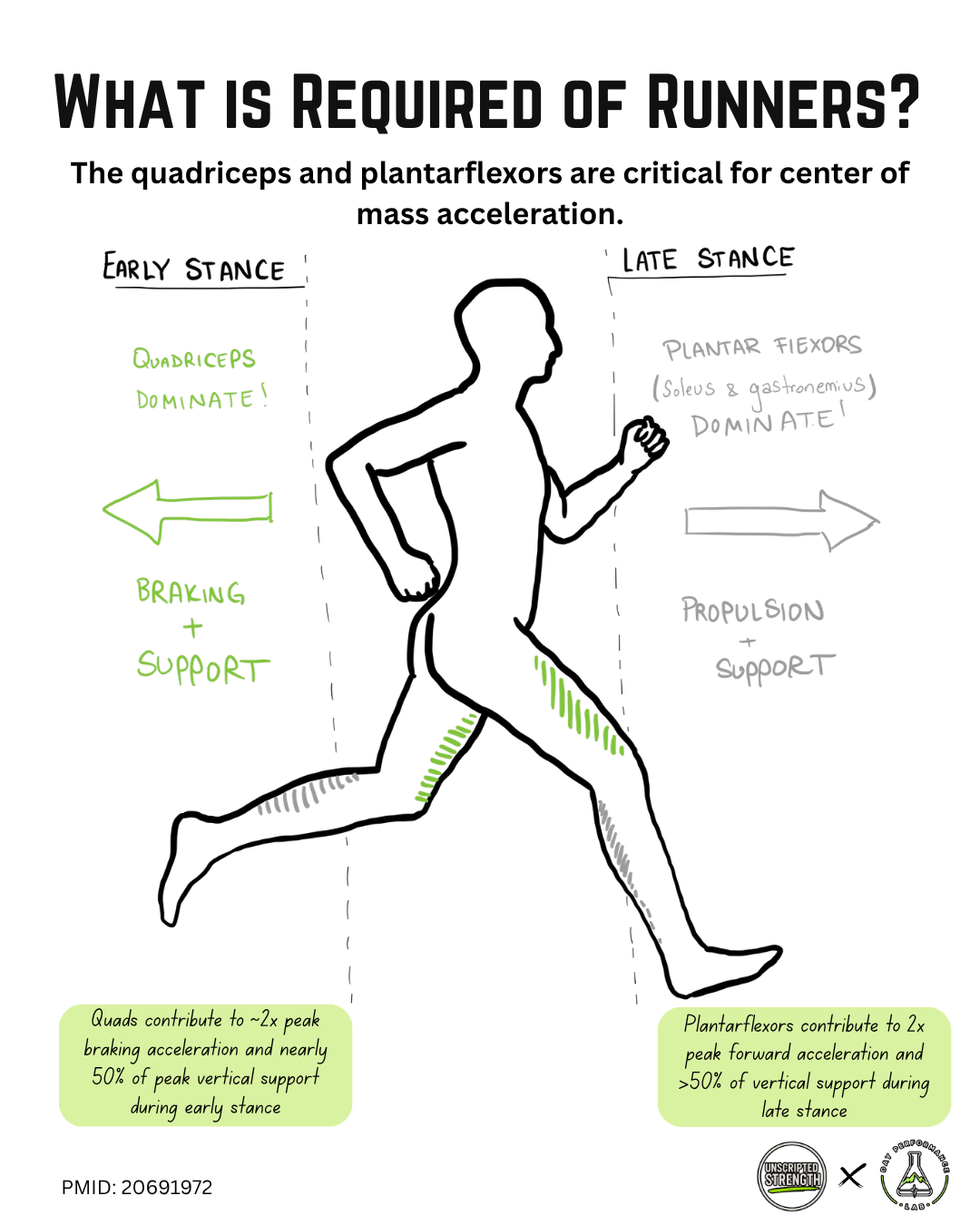
One biomechanics study used musculoskeletal modeling to determine which muscles contribute most during running (Hamner et al). Below are the findings:
Quadriceps dominate during early stance, controlling braking forces and providing nearly 50% of vertical support
Soleus and gastrocnemius (plantarflexors) dominate during late stance, generating approximately 2x the peak forward acceleration and providing more than 50% of vertical support.
Runners need to have strong quadriceps to absorb impact, strong plantarflexors to generate propulsion, and the ability to repeat this thousands of times. Although they are major players, they aren’t the only ones working during the run. Efficient running is a whole-body movement. Research summarized by Zemková emphasizes that successful runners require:
Efficient core function
Hip stability
Neuromuscular coordination
Leg stiffness
Rapid force production
These qualities allow runners to stabilize the pelvis, efficiently transfer force, coordinate movement, minimize wasted energy, and improve running economy.
Why is hip stability important?
The hip is the controller of lower limb mechanics. If the hip and pelvis are unstable, the ankle and knee cannot apply force efficiently, regardless of how strong they are. During running, every step is essentially a single-leg stance and during mid-stance, the stance leg must:
Support 2-3x body weight.
Prevent excessive pelvic drop.
Control femoral adduction and internal rotation.
Provide a stable base for force production.
Transfer force from the trunk to the lower limb.
If hip stability is poor, the leg becomes a less efficient spring.
Why is leg stiffness important?
Leg stiffness helps runners recycle elastic energy, reduce ground contact time, minimize muscular work, and improve running economy. This allows them to produce force more efficiently over thousands of consecutive strides.
What is neuromuscular coordination?
Neuromuscular coordination is the ability of the nervous system to recruit the right muscles at the right time and in the right sequence, allowing runners to produce force efficiently, maintain stable running mechanics, and minimize energy loss with every stride.
The Force-Velocity Curve
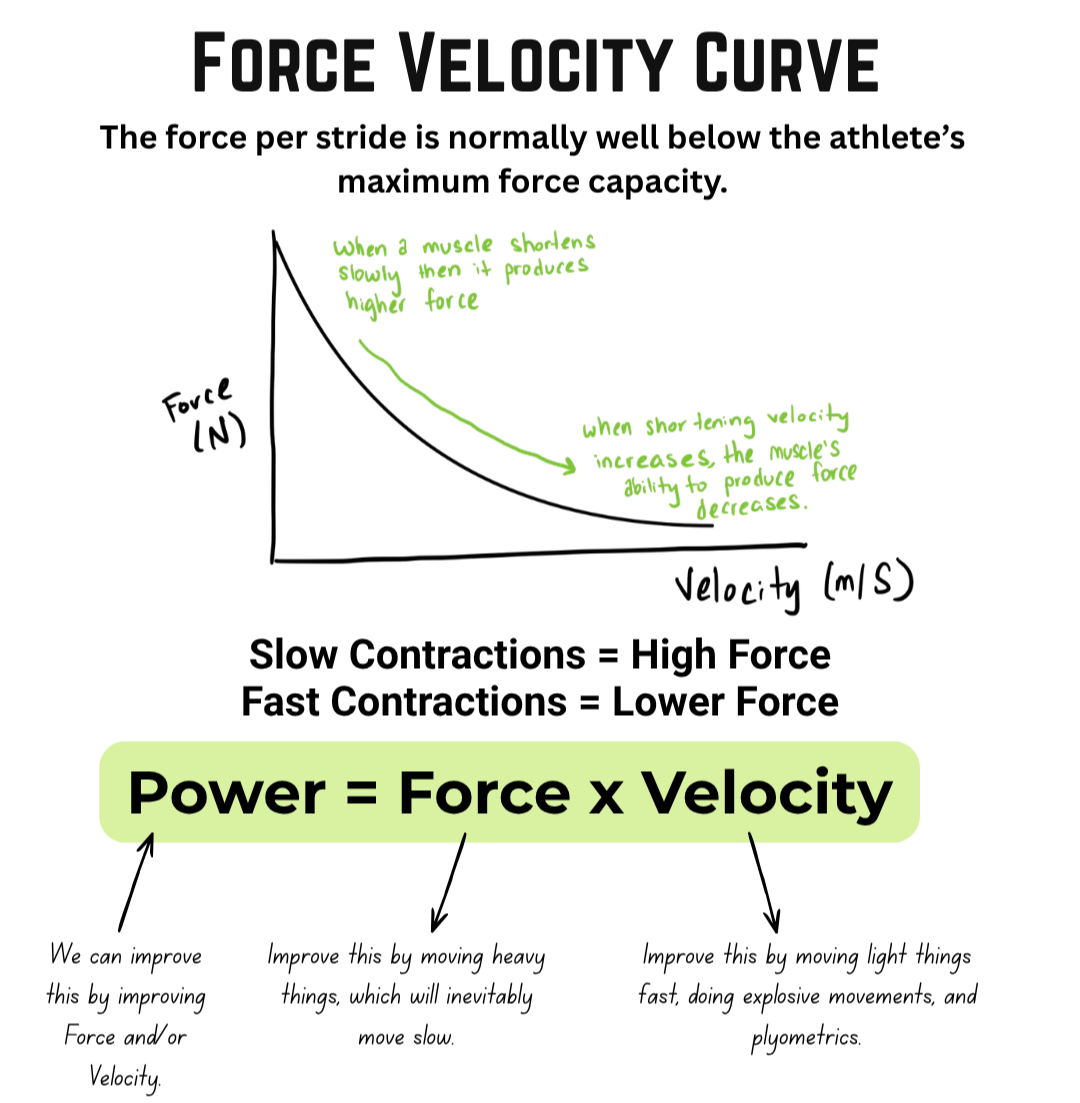
When I first started in the career field of strength and conditioning, one of my early mentors told me “if you understand the force-velocity curve, you will understand almost every foundational piece of performance”. And I think he made a great point; the F-V curve tells us so much and is a great way to approach training athletes.
Some history: nearly a century ago, A. V. Hill demonstrated that muscles cannot produce maximal force and maximal velocity simultaneously. As contraction velocity increases, force decreases. And vice versa, as contraction velocity decreases, force increases.
Power is the product of both: Power = Force x Velocity
Runners must improve both qualities, force and velocity. Heavy strength training develops the high-force end of the curve and force production. Meanwhile, plyometrics and explosive exercises develop the high-velocity end. Doing solely bodyweight exercises does not improve the force ceiling and it keeps the athlete limited in their capacity to produce higher power outputs.
Surf the F-V Curve! Include training across the spectrum. Lifting relatively heavy loads is important, but it should not be the only focus. As I mentioned above, running requires repeated submaximal power production, not one maximal effort. So we have to focus on building the force production/force ceiling (higher loads, closer to maximal effort) and increasing the speed the muscles contract (light and explosive movements).
Why do we need heavy lifting?
increases maximal force capacity.
raises the athlete's "ceiling".
makes each running stride require a smaller percentage of maximal force.
Why do we need explosive training?
improves rate of force development.
enhances neuromuscular coordination.
improves running economy.
increases reactive strength.
Why Do Plyometrics Matter?
improves rate of force development.
improves reactive strength.
increases leg stiffness.
improves elastic energy return.
increases stretch-shortening cycle efficiency.
These qualities allow runners to produce the required force in less time while relying more on elastic recoil and less on metabolically expensive muscle contractions. Ultimately this leads to improved running economy.
What the Heck is Leg Stiffness?
Leg stiffness is a quality that is very important for runners; when you have low leg stiffness (a floppy leg), then there is a lot of energy dissipation. Every foot strike stretches the Achilles tendon and surrounding tissues before they recoil like a spring. Greater leg stiffness helps runners recycle elastic energy, reduce ground contact time, reduce muscular work, and ultimately improves running economy. Recent studies show that athletes who could move moderate-to-heavy squat loads explosively (50–80% 1RM) exhibited greater leg stiffness. This shows that velocity-focused resistance training should be done in addition to heavy lifting (García-Ramos et al.), which we mentioned above.
What about Core Training?
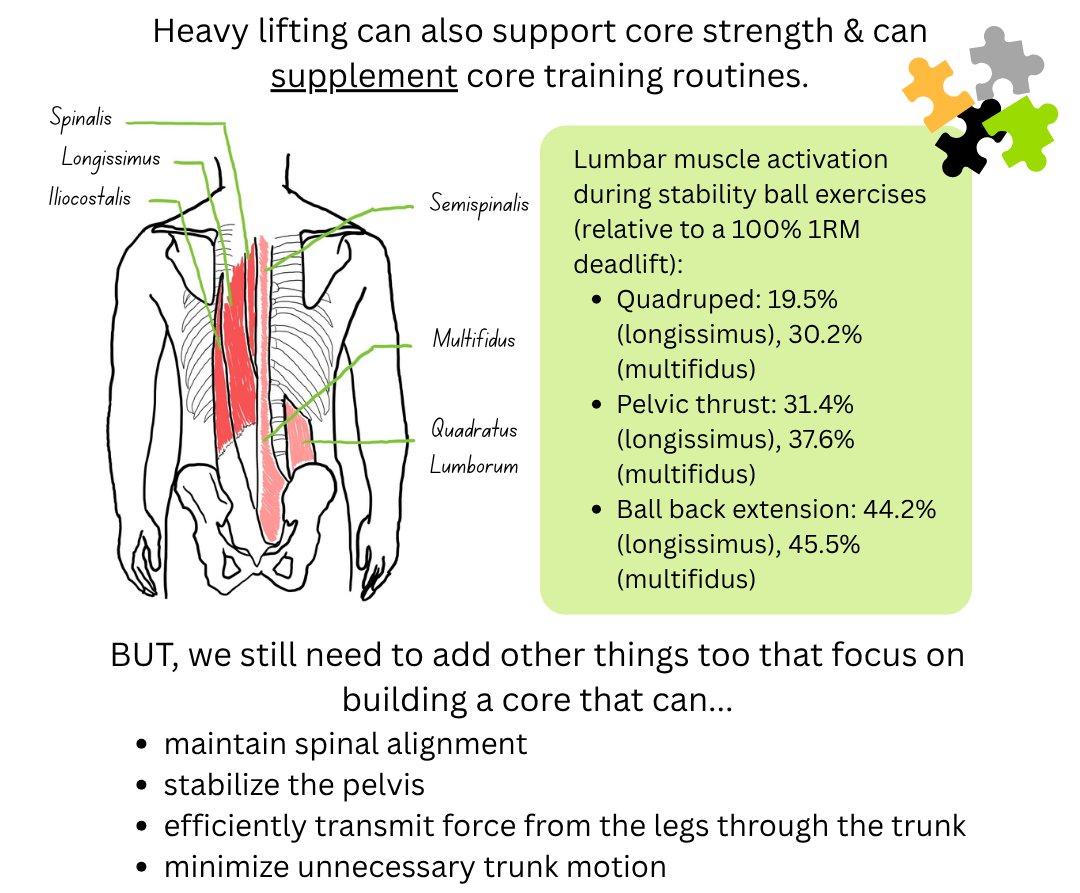
I’ve seen a lot of endurance athletes do endless planks or crunches, but research suggests something different. Heavy squats and deadlifts activate the lumbar musculature exceptionally well, often producing greater trunk activation than common stability-ball exercises (Nuzzo et al.).
But heavy squats and deadlifts should not be the only thing for core training. Runners still need additional exercises because the core's job during running is responsible for:
maintaining spinal alignment.
stabilizing the pelvis.
transfering force between the legs and trunk.
minimizing unnecessary movement.
We Talked about the Quads/Plantar Flexors, what about the Hip?
Running is essentially a series of single-leg jumps and with every stride, it requires the stance leg to stabilize the pelvis while controlling the femur underneath the body. Good hip stability improves force transfer, maintains pelvic alignment, controls hip adduction, limits excessive internal rotation, and supports efficient lower-limb mechanics. The hips serve as the bridge connecting the legs to the trunk.
How much Strength Training do Runners Need?
As always, it depends, but I recommend aiming for the minimum effective dose. For most endurance athletes who are running 40+ miles per week or training 15+ hours per week, 2-3 strength sessions per week is usually enough to get the adaptations while preserving recovery for running. I recommend that each session ranges from 30-60 minutes and includes quality movements ranging from heavier compound exercises, plyometrics, core, and multi-planar movements. Strength training should complement, not compete with, the athlete’s running training, which ultimately is their priority. The exact strength program should depend on training phase, running volume, individual weaknesses, injury history, and race goals.
Overall
The strongest runners are not similar to powerlifters or strength athletes, they are the ones who can produce force efficiently, transfer it through a stable body, recycle elastic energy, and repeat that process thousands of times with minimal energy loss.
References
Bassett DR Jr. Scientific contributions of A. V. Hill: exercise physiology pioneer. J Appl Physiol (1985). 2002 Nov;93(5):1567-82. doi: 10.1152/japplphysiol.01246.2001. PMID: 12381740.
Hamner SR, Seth A, Delp SL. Muscle contributions to propulsion and support during running. J Biomech. 2010 Oct 19;43(14):2709-16. doi: 10.1016/j.jbiomech.2010.06.025. Epub 2010 Aug 9. PMID: 20691972; PMCID: PMC2973845.
Jaén-Carrillo D, Cartón-Llorente A, García-Ramos A, Santos L. Mechanical Variables Derived From Submaximal Back Squat Performance Are Positively Associated With Running Performance in Highly Trained Endurance Athletes. J Strength Cond Res. 2026 Jul 1;40(7):799-806. doi: 10.1519/JSC.0000000000005402. Epub 2026 May 18. PMID: 42139598.
Nuzzo JL, McBride JM, Cormie P, McCaulley GO. Relationship between countermovement jump performance and multijoint isometric and dynamic tests of strength. J Strength Cond Res. 2008 May;22(3):699-707. doi: 10.1519/JSC.0b013e31816d5eda. PMID: 18438251.
Nuzzo JL, McCaulley GO, Cormie P, Cavill MJ, McBride JM. Trunk muscle activity during stability ball and free weight exercises. J Strength Cond Res. 2008 Jan;22(1):95-102. doi: 10.1519/JSC.0b013e31815ef8cd. PMID: 18296961.
Seow CY. Hill's equation of muscle performance and its hidden insight on molecular mechanisms. J Gen Physiol. 2013 Dec;142(6):561-73. doi: 10.1085/jgp.201311107. PMID: 24277600; PMCID: PMC3840917.1
Zemková E. Perspective: A head-to-toe view on athletic locomotion with an emphasis on assessing core stability. Sports Med Health Sci. 2025 Jul 4;8(4):474-478. doi: 10.1016/j.smhs.2025.07.001. PMID: 42282455.
