
My Experience with Loaded Running
One of my research projects is centered around the physiological effects and immune system response to loaded running. I joke around that it’s kinda obvious; we know that running with a backpack is hard, I’m pretty sure that a toddler could tell you that. If we add on a 20-kg (45-lb) backpack, we can all agree that it’s going to add a level of difficult that we don’t experience with unloaded running. That being said, there’s a lot of information we don’t know such as…
The magnitude and significance of the impact — how much more do immune cells mobilize? at what point? how much earlier do we reach lactate threshold? ventilatory threshold?
The differences in rate of immune cell mobilization, lactate build-up, VO2max increases.
Performance implications.
Impact of confounding variables such as age, fitness level, VO2max, sex.
If we know this information, we could potentially provide interventions for the populations who are exposed to this type of training (military, law enforcement, etc) OR we can use load as a prescription for blood-donor exercise protocols for cancer cell therapies.
This most recent semester, I participated in the study to collect data on myself and experience it firsthand. In this article, I will talk about my experience, the data collected, and the subjective information from me.
The Protocol
There are two exercise visits, separated by 2-6 weeks, depending on availability. The first visit is an unloaded treadmill protocol, the second visit is a loaded (20 kg/45 lb) treadmill protocol. For each visit, the subject is fasted for at least 8 hours and has to wear combat boots and combat trousers.
For each exercise trial, the subject is expected to go to maximal exhaustion. We place an IV in the arm to draw blood after each exercise interval, and hook up the subject to a metabolic cart using a face-mask so that we can collect breath-by-breath data.
Unloaded Running
The intervals are 3-minute stages with increasing pace each stage, at 1% incline. There is a 1-minute rest period between each stage, so that we can take out blood from the IV.
Stage 1 is 6.4 km/hr and it increases by 1 km/hr, until 12.4 km/hr (stage 7).
If the subject makes it to the 12.4 km/hr stage (stage 7), then we no longer increase pace. Instead, we start increasing incline by 2.5% every minute (with no rest between these sets) until max exhaustion.
Loaded Running - same as the unloaded running, but with a 20-kg/45-lb backpack.
Background
I did the unloaded visit on February 26, 2026
This was the day after my first exam of my semester, so I was “coming down” from a high level of stress.
My WHOOP data the day of:
Sleep: 7:39
RHR: 63 bpm
HRV: 76 ms
I did the loaded visit on April 9, 2026.
This was the day another exam, so I was also “coming down” from a high level of stress and subjectively I would say I had a high level of psychological stress .
My WHOOP data the day of:
Sleep: 7:54
RHR: 58 bpm
HRV: 95 ms
My Experience
First, I will say it was a very fun study and it was tough, especially as a smaller person (5’ 2” and 115 lbs).
The Data
All of the data is collected below. I won’t get into too much detail for each, as I just want to highlight the trends and the impact that adding load has.
Cortisol:
Cortisol has a bad reputation and is infamously known as the immunosuppressive stress hormone. When people hear about cortisol, they automatically think “bad”. I won’t get into the detail of stress physiology here or cortisol’s role in immunoregulation and its balance of permissive and suppressive actions, but I do want to note what we see in the graph below:
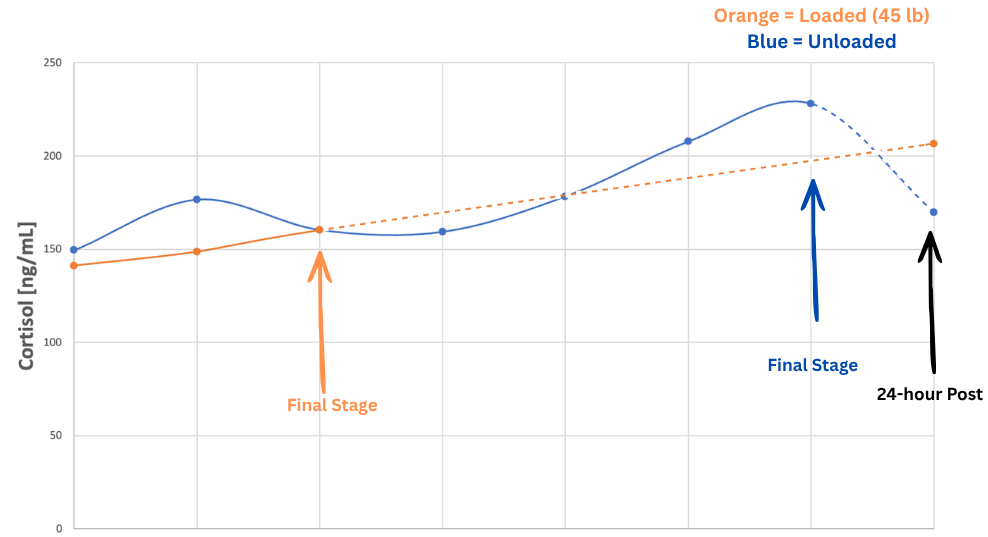
Cortisol was measured using an ELISA (enzyme-linked immunosorbent assay) . The samples used in the ELISA were the subjects' blood serum. For reference, typical physiological concentration in the morning range from 100 - 200 ng/mL.
For the unloaded trial, you can see that cortisol fluctuates but the change is not too significant until closer to the final stage, which makes sense. However, I would want to repeat this trial several times before jumping to conclusion on the unloaded cortisol response. One recent study that came out in April 2026 showed that cortisol production/secretion is significant when exercise is longer duration (~40 minutes) and that shorter sessions do not elicit cortisol release. Exercise trials of this duration may not have a significant change in cortisol. However, there are other things to consider beyond duration such as intensity, and confounding variables (sex, age, fitness level).
For the loaded trial, you can see that I ended way earlier and even though it was intense, the duration was not long enough for cortisol secretion. However, the 24-hour cortisol was significantly higher and did not return to baseline. If I had to guess, I would say that the 20-kg backpack had greater inflammation and tissue repair following the loaded trial, which leads to higher cortisol (which releases the anti-inflammatory cytokines to regulate the immune system). The reason I believe this as a viable hypothesis is because I was extremely sore the following three days to the point that I could not squat to use the toilet without a ton of pain.
Lactate:
The lactate curve below is really fun. There are many things causing the lactate to spike a lot faster with load versus the more gradual increase in the unloaded (increased demands on the muscles, increase in sympathetic nervous system activation, increased physiological demand).
One thing that I want to focus on is that with the load, there is an increase in force production required with each step to support the load and to propel me forward. With that higher force production, theres a greater requirement of ATP turnover/demand, which in turn forces the glycolysis system to kick in to a greater extent, leading to an increase in lactate.
In addition to that, at the same speeds. the loaded run represents a higher percentage of my physiological capacity (which we will see in the VO2 graph below).
In both cases, my lactate returned to it’s baseline, which is as expected.
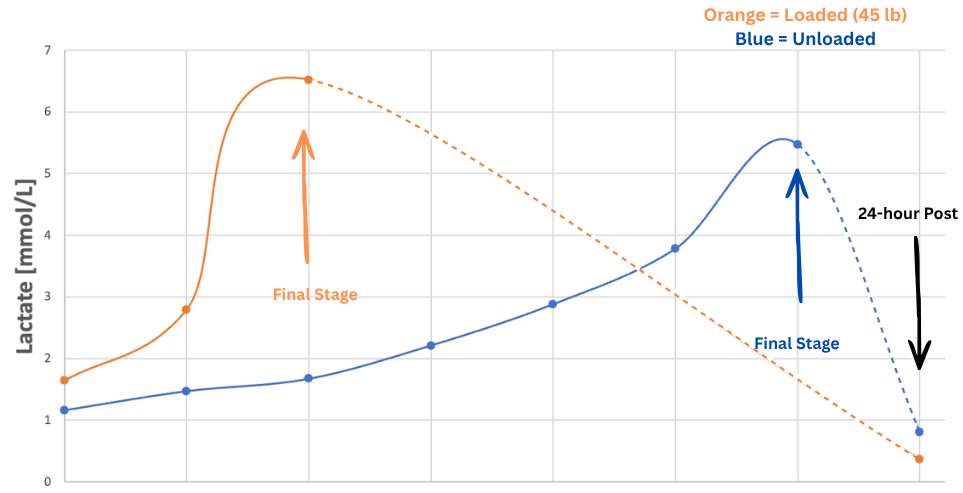
Lactate was measured using an enzymatic colorimetric assay. The samples used in the ELISA were the subjects' blood serum. For reference, typical physiological concentration of lactate at rest is 0.5-2.0 mmol/L.
Heart Rate:
My max heart rate recording for the unloaded was 205 bpm, and for the loaded it reached about 185 bpm. Although the loaded running was more difficult, I could not push myself aerobically because the load was relatively heavy and it prevented me from going to my cardiovascular maximal effort. My limiting factor was my strength and force production required to maintain the speed under the load, versus my aerobic fitness.
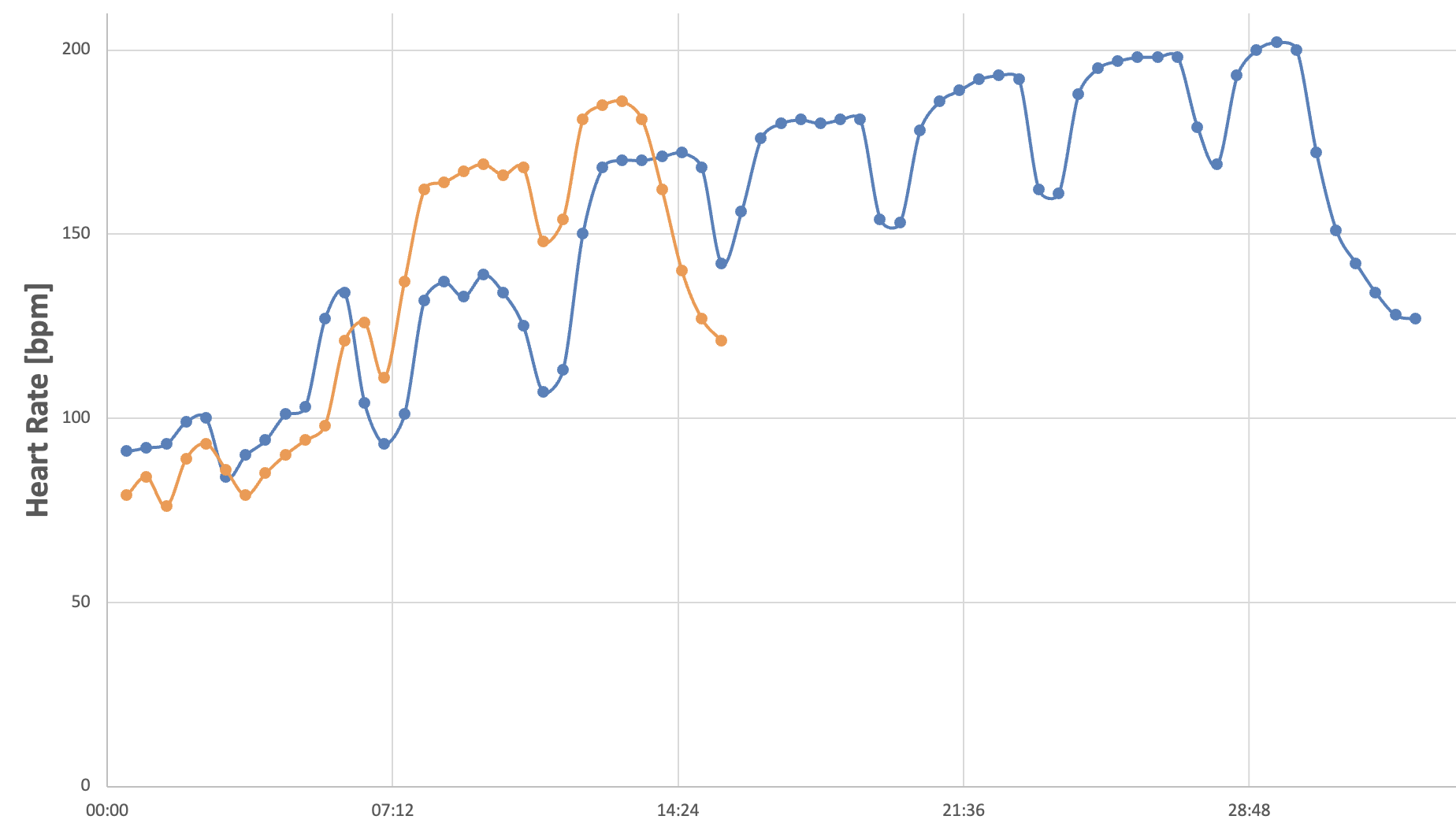
Heart rate was measured throughout the protocol using a Polar Chest Strap.
VO2:
Similar to the heart rate, I was not able to reach the unloaded peak VO2 because the force production required was the limiting factor, versus my aerobic fitness. However, the VO2 was significantly higher in the loaded trial versus the unloaded. If you remember Fick’s equation for VO2, you know that VO2 = (cardiac output) x (arterial-VO2 difference). In this case, my heart rate was significant higher in the earlier stages which reflects the increase I see in my VO2.
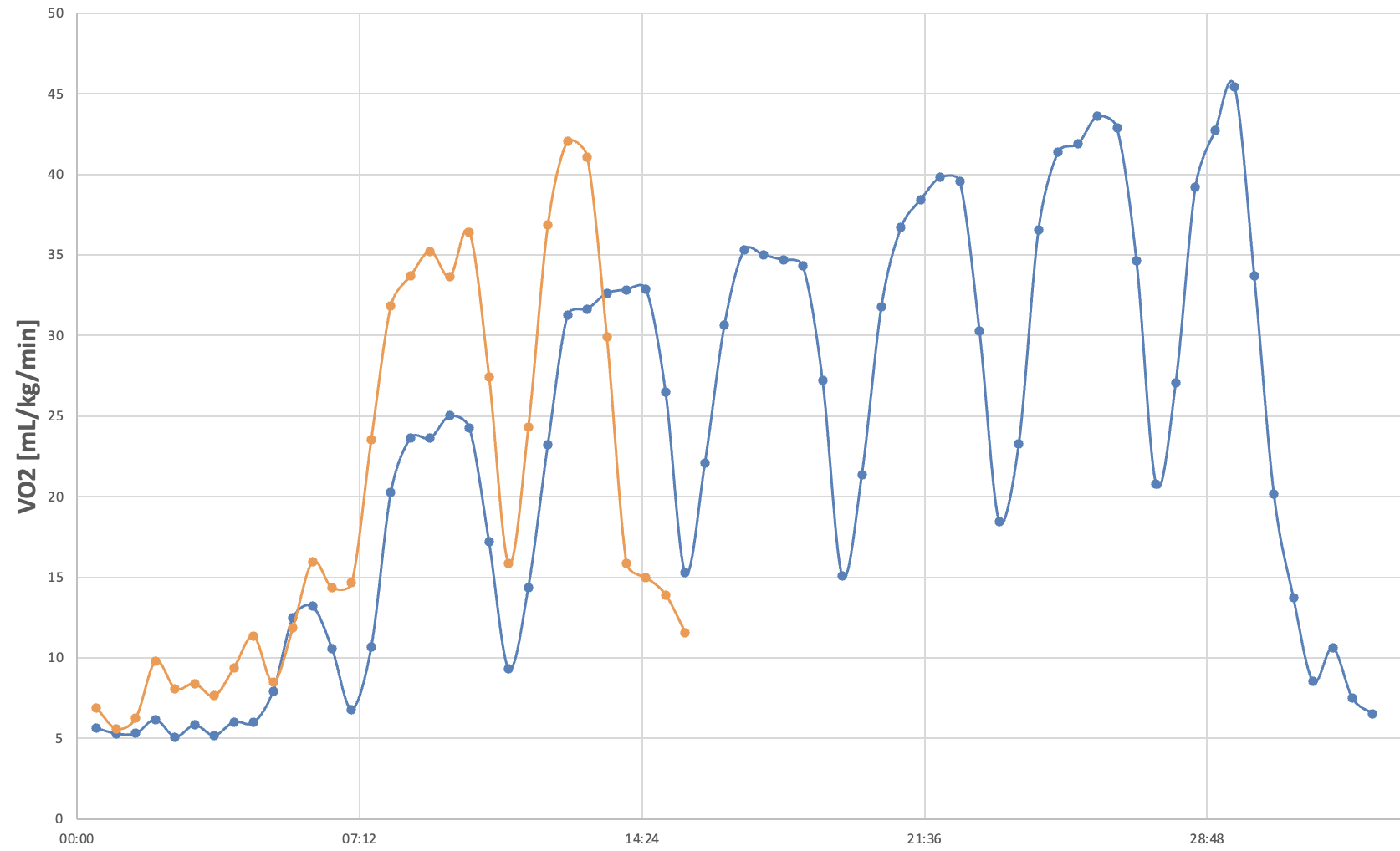
Relative VO2 was collected from the metabolic cart.
My WHOOP data the day after:
Unloaded:
Sleep: 7:05
RHR: 69 bpm
HRV: 50 ms
Recovery: 29%
Loaded:
Sleep: 7:40
RHR: 64 bpm
HRV: 60 ms
Recovery: 33%
Key Takeaways
Reminder that this information is just for one person and you can’t draw any crazy conclusions from it, since it is simply an n=1. But it does provide some interesting information and allowed me to take a deeper dive in my own training and performance.
Cortisol response did not fluctuate much during the loaded trial because it was so short. However, it did impact me on a more long-term scale and elevated my cortisol levels the next day. This could be due to the increase in inflammation for repair, which in response cortisol increased.
Although wearables aren’t the gold standard, the trends they provide can be useful. In my case, the WHOOP detected a decrease in my resting performance measurements (HRV and RHR) for both trials, which makes sense because I went maximum effort for each.
The loaded protocol made me SO sore for the next three days, which is unusual for me. This was a completely new stimulus for me that I definitely was not used to.
If I were looking to specifically improve my loaded running performance I would do the following:
My biggest priority is exposing my body to the stimulus of the load. I would introduce loaded running and sprinkle it into my program.
I would progress appropriately. I would probably start by adding in 10-kg load for 1-2 longer cardio sessions a week.
The cardio sessions would be incline walking to slow jogging. I would not go with anything too intense.
After a few sessions, or whenever I deem it appropriate based on my RPE, I would increase the weight of the load by 2-3 kg.
My VO2max was fairly average, maybe a bit above average at that (44 mL/kg/min unloaded and 42.5 mL/kg/min loaded). There is some room for improvement here. I would do 2 sessions per week of a VO2max style workout, without load. In this session, I would do max effort intervals in 3 minutes, and I would start at 4×3:00 for 2x per week. I would see how much weekly time I can accumulate at this intensity.
