
The Lactate Threshold is Not a Physiological Switch
First, what is lactate?
Your body uses carbohydrates to produce energy. As glucose is broken down through glycolysis, lactate is formed. If you were to look at the process of how lactate is formed, it looks like this:
You eat carbohydrates
Those carbohydrates are broken down into glucose.
Glycolysis breaks glucose into even smaller molecules (this occurs in the cytoplasm of the cell and does not require oxygen to begin).
Energy is released as ATP (adenosine triphosphate, the body’s energy currency).
Eventually, the glucose continues to break down and the resulting product of glycolysis is lactate.
Glycolysis happens without oxygen, therefore it is an anaerobic pathway.
What is lactate threshold? Why do people test it?
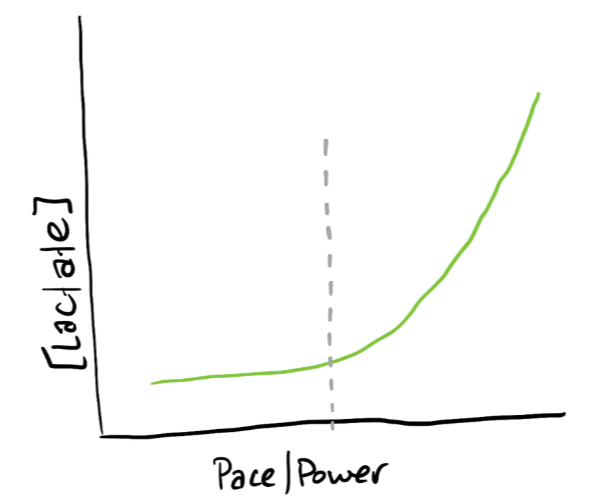
Later in this article, we will discuss lactate threshold more deeply, but for now we will say that lactate threshold is the point where blood lactate starts accumulating. If you were to look at a lactate curve (to the left), you will see that blood lactate increases with increasing intensity and there is a point where there is a sharp increase in lactate and the slope increases; that point is the lactate threshold.
At lower intensities, lactate production and lactate clearance are more balanced. As intensity increases, lactate production rises. Eventually, you will reach an intensity where lactate starts accumulating in the blood faster than it can be cleared.
Athletes measure lactate threshold because it provides insight into how their body responds to increasing exercise intensity. Identifying the intensity where the threshold occurs helps athletes and coaches establish training zones, monitor physiological adaptations, and track improvements in endurance performance over time.
The lactate threshold is not a physiological switch
Now that we’ve introduced lactate, lactate thresholds, and its use for athletes, let’s talk about what the lactate threshold represents. Oftentimes, crossing the lactate threshold is thought of as a switch that shows when we suddenly become "anaerobic". This is an oversimplification.
As mentioned above, the lactate curve shows the blood lactate concentrations at increasing power/paces. In the curve, there's a point where you'll see an increase in blood lactate concentrations. This is the threshold that is often thought of as the aerobic to anaerobic "switch", since it’s the point where lactate starts building up so the anaerobic pathway (glycolysis) must be dominant.
However, here is the truth: lactate is produced continuously, even at rest. What changes during exercise is the relationship between how much lactate you're producing and how much you're able to clear and use as fuel. Instead of viewing the lactate threshold point as a switch, think of it as a faucet and drain. There is a balance between production (faucet) and clearance/utilization (drain). The threshold point is where the faucet's rate is starting to overpower the rate of the drain.
The lactate threshold point isn't a switch. It's the point where rate of production exceeds the rate of clearance/ utilization, due to the intensity of the exercise (which relies more on the glycolytic pathway). Because of that, we see a build-up in the amount of lactate in the blood. Rather than serving as a marker of when the body suddenly becomes "anaerobic," lactate threshold testing offers a practical way to understand the relationship between energy production, lactate metabolism, and sustainable exercise intensity.
Lactate Production and Clearance
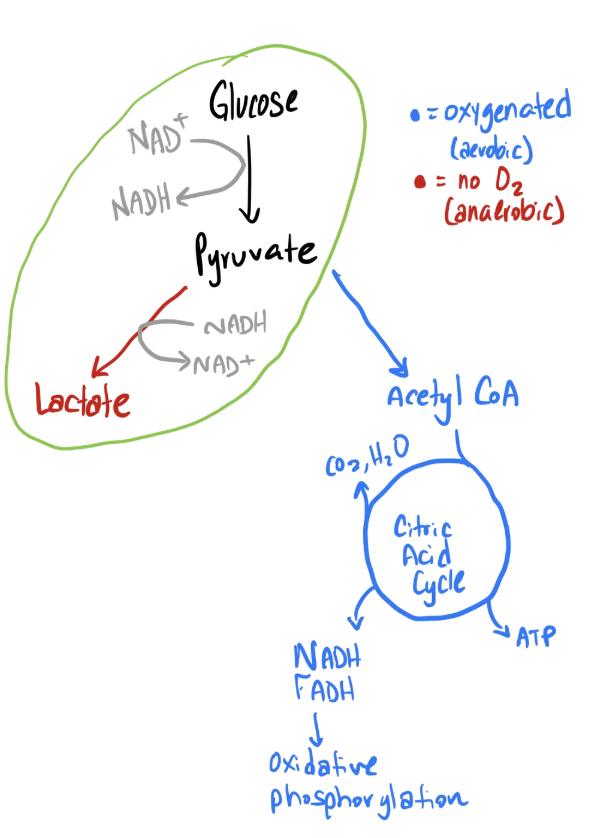
Lactate production is a result of the glycolytic pathway (circled in green). If an athlete can tap into this pathway at a higher capacity (power athletes, for example), then they will be able to produce lactate at higher concentrations.
Lactate production depends on:
Glycolytic capacity
Fast-twitch fiber recruitment
Exercise intensity
VLamax (maximal glycolytic rate)
If an athlete is very powerful and more of a sprinter, then we can assume they have high levels of lactate production because they can tap into the glycolytic energy system at a higher capacity, versus someone who trains more in an endurance capacity.
Side note: VLamax is how quickly your muscles can produce energy through glycolysis and generate lactate.
An endurance athlete has a high capability of lactate clearance. Endurance training develops the machinery needed to transport, utilize, and oxidize lactate as a fuel. This includes things like:
More mitochondria/higher mitochondria density
Increased expression of proteins called monocarboxylate transporters (MCTs). These are lactate transporters that move lactate to tissues that can oxidize it, heart, and slow-twitch muscle fibers.
More oxidative muscle fibers, which are great at oxidizing lactate and using it as fuel.
Greater blood flow from increased capillary density, cardiac output, and tissue perfusion.
When you look at an athlete’s lactate curve and threshold, you have to consider multiple things. For example, an athlete may have high lactate values because they produce a lot, not because they clear poorly...and vice versa.
Summary and Takeaways
The shape of a lactate curve is influenced by multiple physiological factors, such as glycolytic capacity, mitochondrial function, lactate clearance, fiber type recruitment, and training adaptations. It's not a direct measure of energy system use, but rather an outcome of how these systems interact during exercise and the balance between production and utilization.
High lactate does not automatically mean poor fitness - It could reflect greater glycolytic contribution.
Lactate threshold is a balance point - It reflects production versus clearance rather than an "on/off" anaerobic switch.
Lactate curves are not the whole story - Two athletes can have similar performance but very different lactate profiles.
Context matters - Lactate should be interpreted with VO₂max, performance metrics, and training background.
